
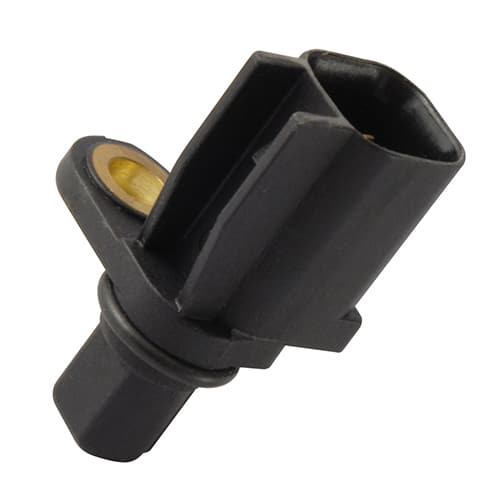
ABS (Anti-lock Braking System) or Wheel Speed Sensors, are mounted in the hub of the wheels and detect the rotational speed of each of them, transferring this information to the ABS control unit. If the ABS control unit detects a substantial drop in speed in one or more wheels, which could cause them to lock, it swiftly intervenes by modulating the braking pressure of each wheel individually. This prevents the wheels from locking and guarantees safe braking, allowing the driver to retain control of the vehicle.
Description
Technical data
Composition
Cause of failure
Mounting
Description
What is an ABS Sensor or Wheel Speed Sensor?
ABS (Anti-lock Braking System) or Wheel Speed Sensors, are mounted in the hub of the wheels and detect the rotational speed of each of them, transferring this information to the ABS control unit. If the ABS control unit detects a substantial drop in speed in one or more wheels, which could cause them to lock, it swiftly intervenes by modulating the braking pressure of each wheel individually. This prevents the wheels from locking and guarantees safe braking, allowing the driver to retain control of the vehicle.
The ABS sensors provide information not only for the system itself, but also for such other systems as the gearbox, satellite navigation systems, the TCS or ASR (Traction Control Systems), chassis control systems, the ESP (Electronic Stability Program) system or the incline control system, which likewise make use of it.
Given the constant development of such sensors, there are today various different designs depending on precision, size and robsutness requirements.
Types of ABS Sensors
FAE divides these sensors into 2 major groups:
Passive ABS sensors. For toothed wheels.
- Inductive ABS
Active ABS sensors. For wheels with magnetic coding/toothed wheels.
- ABS Hall
- Hall ABS with magnetic coder ring
- Magneto-resistive ABS
Technical data
Passive ABS sensors. For toothed wheels (Inductive)
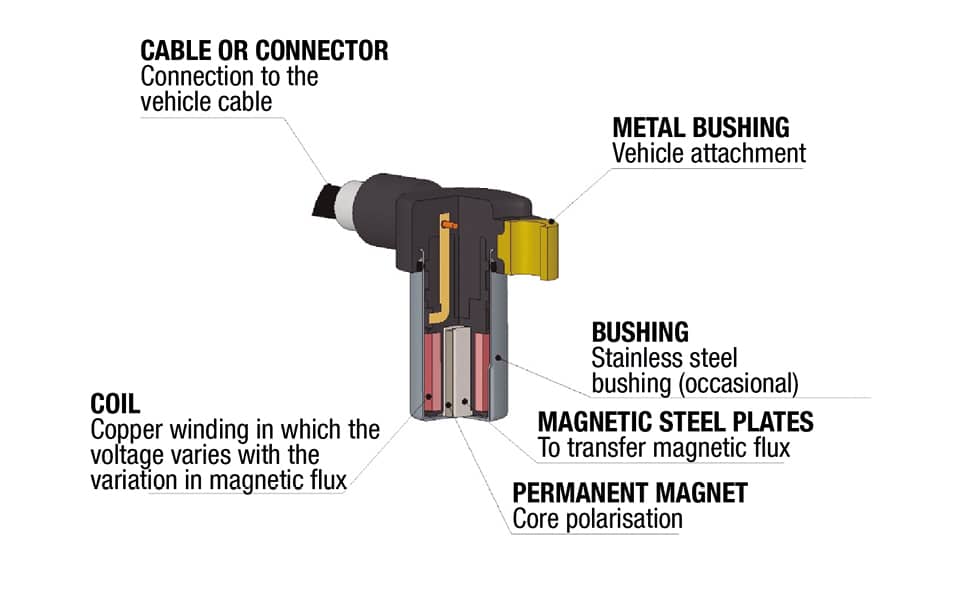
Passive ABS sensors are typically larger and do not begin to function until the wheel reaches a set minimum rotational speed. They comprise a coil wound around a magnetic core and a permanent magnet. The magnetic flow generated between the teeth and troughs of the wheel induce a sinusoidal output voltage proportional to the speed of the variations detected by the sensor. The voltage varies in accordance with the speed of rotation and the gap separating the toothed wheel, in both frequency and amplitude. These variations allow the following to be derived from the signal:
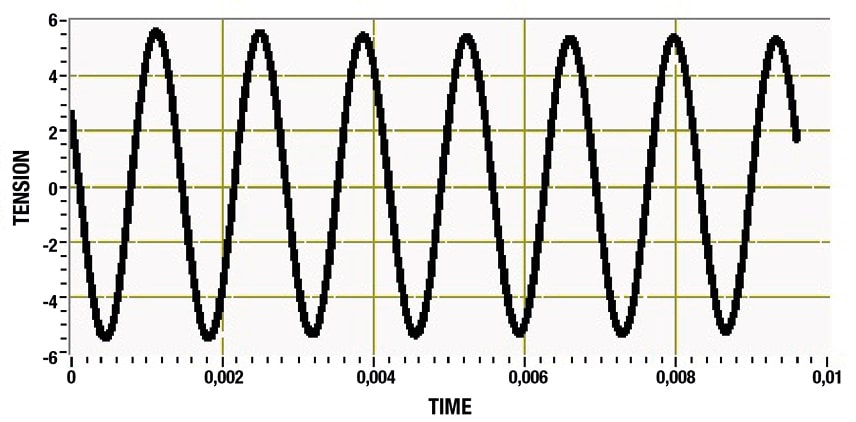
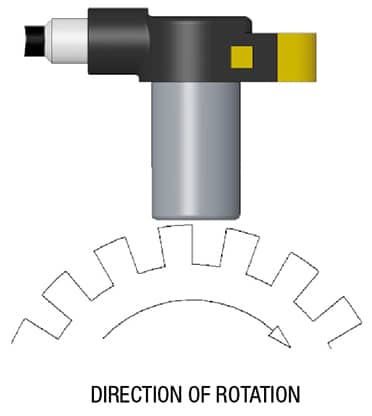


Passive ABS sensors. For toothed wheels (Inductive)
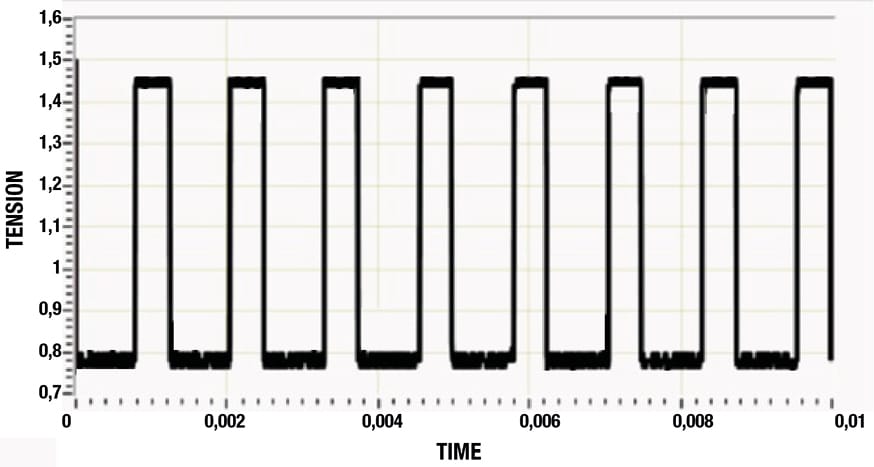
Active ABS sensors are so named because they require an external power input in order to operate.
The operational principle is based on the so-called Hall effect, which comprises the generation of a voltage (the Hall voltage) transversal to the direction of the current in a conductor, when the action of a magnetic field is applied perpendicularly to it.
ABS Hall
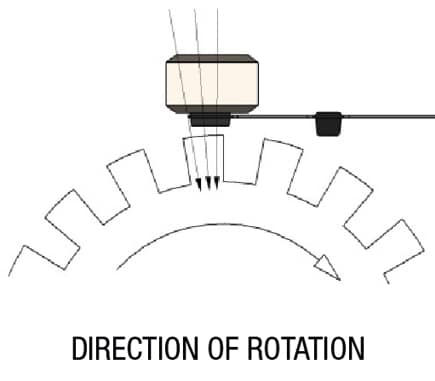
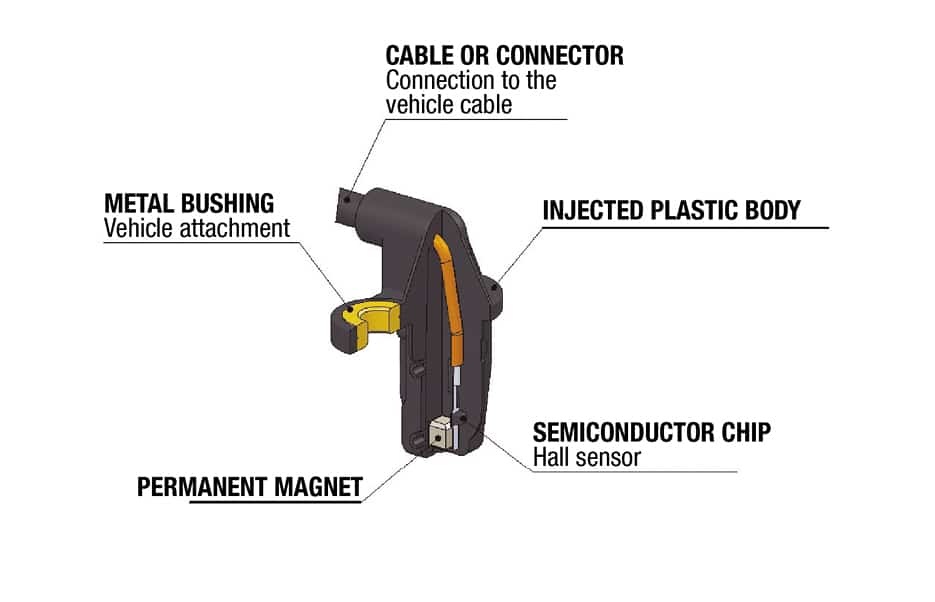
These sensors are highly precise and must be installed with great accuracy. They consist of a semiconductor sensor coupled to an electronic circuit that protects the sensor against possible voltage spikes, together with a permanent magnet. Their operating principle is based on the so-called Hall effect, which consists of the generation of a transverse voltage (Hall voltage) across the direction of current flow in a conductor when a magnetic field is applied perpendicularly to it.
Hall ABS with magnetic coder ring
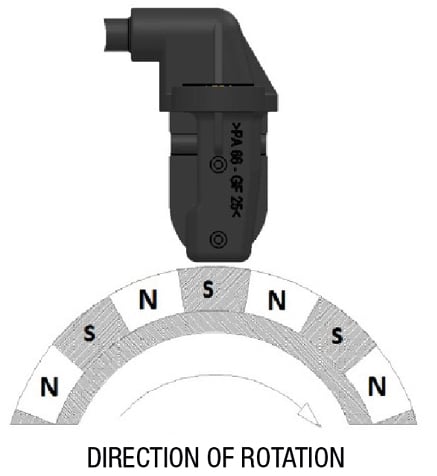
This shares the same principle as the toothed wheel, although the variation in the magnetic field is caused by the change in polarity of a sectionally magnetised wheel (coder disc). No permanent magnet is fitted, thereby reducing the size of the sensor. Space can be saved by fitting the magnetic ring within the wheel bearings.
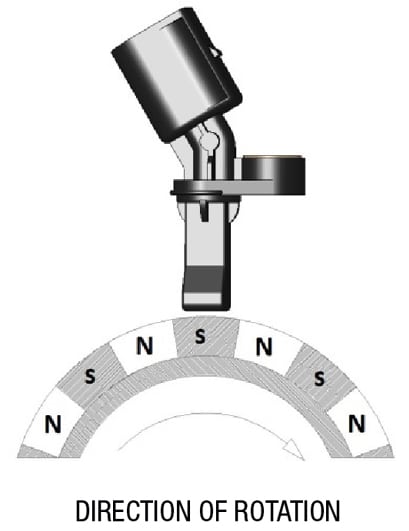 Magneto-resistive ABS
Magneto-resistive sensors are scarcely sensitive to their position, which means that they can be positioned relatively far from the coder disc, and still transmit a reliable signal. These sensors allow a highly precise signal to be detected.
The sensor is mounted above a magnetic coder, its resistive properties varying in accordance with the magnetic field presented to it. As a result of the variation in the internal resistance of the centre, the velocity and direction of rotation can be established.
Composition
Passive ABS sensors. For toothed wheels (Inductive)
Active ABS sensors. For toothed/magnetic wheels
Cause of failure
Common ABS Sensor Faults
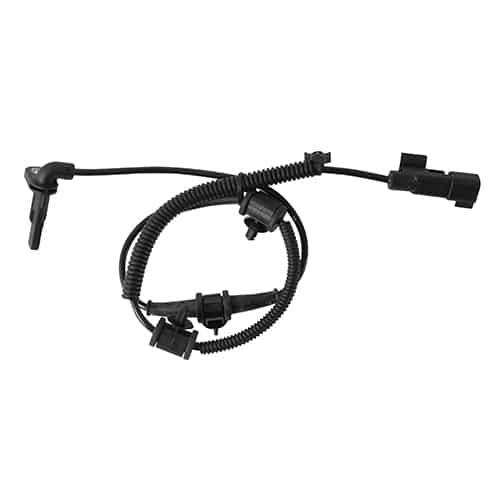
The external housing, connector and cables, as well as the cable grommets, should be inspected to ensure they are in good condition.
Also check whether the sensor shows any cracks, dents or signs of impact that may have caused damage. As a general rule, it should be noted that a visual inspection alone is not sufficient to determine whether the component is functioning correctly or incorrectly; however, it can assist in carrying out an initial diagnosis.
- Cracks or breaks. Tensions provoked by mechanical stress
- Deformations and dents. Overheated sensor
- No signal. Failure of the wire due to friction or excessive vibration, short circuits, internal failure of the sensor due to mechanical or thermal stress.
SYMPTOMS OF WHEEL SPEED SENSOR FAILURE
- The ABS indicator lights up.
- Wheels lock during normal braking (only on cars with an electronic braking distributor).
MAINTENANCE OF WHEEL SPEED SENSORS
Wheel speed sensors are the components subjected to the highest loads within the brake control system.
They prevent wheel slip and help ensure stable vehicle handling on the road.
Check the sensor-specific values during every service interval or every 25,000 km.
Replace the sensors if the operating checks fall outside the specified limit values.
Mounting
